Macro on a circuit card
Lumen is an optical inspection rig for assembled boards. The camera looks through a macro lens so 0402s, QFP toes, and solder fillets fill the frame. Depth of field collapses at that working distance. A single snapshot is never the whole story, and it is never the whole card.
The job is to get a sharp, well-lit mosaic of the assembly, then run processing that makes joints, edges, and missing parts obvious.
Tiling and focus stacking
Image tiling walks the card in overlapping frames and stitches them. You inspect a 100 mm board at macro resolution without pretending one sensor covers it. Overlap is the cheap insurance against stitch gaps and local warp.
Focus stacking takes the same tile at several Z positions and keeps the sharp pixels. Tall parts (crystals, connectors, shields) and the pad plane cannot share one focus at macro. Stack first, then tile, or you stitch blur into the mosaic.
Addressable lighting
Solder is a mirror. A single always-on ring makes one set of fillets pop and hides the rest in glare. The lights on this rig are digitally addressable: segments commanded in software, no one in the light path. Grazing for texture and tombstones, steep for pad fill, side-on for pin rows. Store the channel map with the frame. You cannot compare two inspections if the lighting was a different recipe.
Polarization is still manual. A crossed polarizer on the source and analyzer on the lens knocks down specular bounce from mask and solder so the fillet shape stays visible instead of a white blob. Rotate the pair and you choose how much gloss you keep. Some defects only show up when the glare is gone; some only show up when it is there. Both shots are useful. That rotation is not on the same digital path as the ring yet.
Capture vs process
Same patch of a board, two views. Left is the raw macro frame (crystal, SOT-23, 0402s, QFP toes). Right is a processed pass that pulls fillets and pin edges forward.
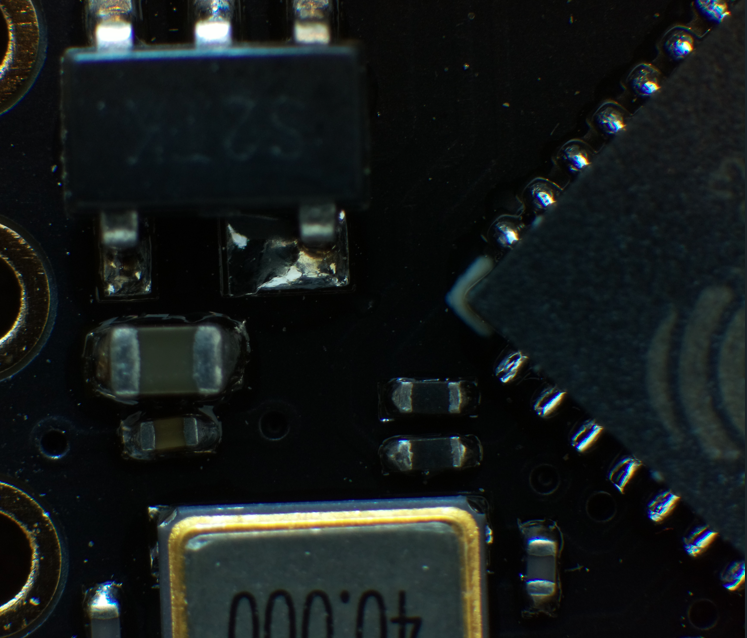
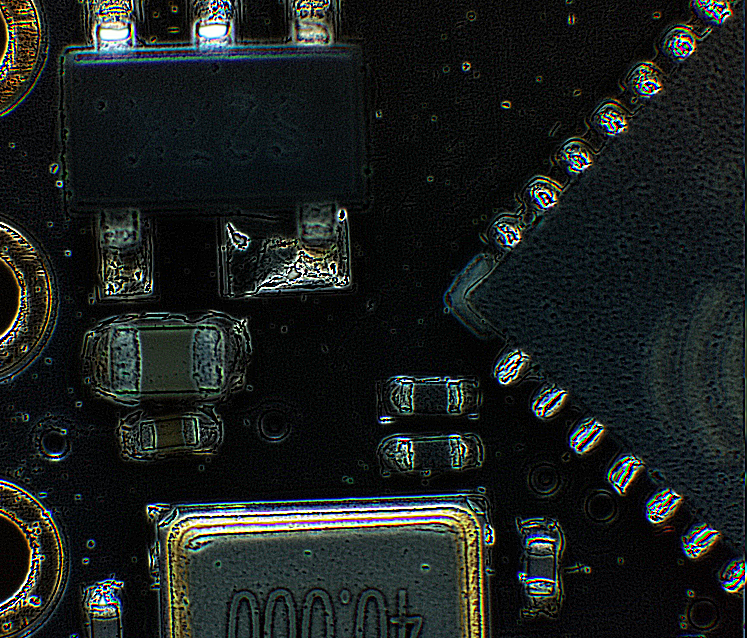
Same patch of board. Capture is the raw macro frame. Process is a pass that pulls fillets and pin edges forward.
What you keep
Frames, tile pose, focus index, and the lighting recipe (which segments, elevation). If those travel with the image, you can replay the same illumination, compare two builds of the same card, and hand a call list to something that already knows refdes. The IPC-2581 viewer is the obvious place to pin a box to R12 instead of a pixel. Polarizer angle is still a note you take by hand.
Still to do
Tighter stitch on warped boards, stacking that does not smear silkscreen. Put polarization on the same digital path as the ring so a recipe is fully repeatable without touching a filter.
references